On-premise vs cloud AI in the UAE: how to choose
Four deployment models, not two. Start with the transfer question, then the utilisation curve. An honest account of what each option costs you.
Key takeaways
- The choice is not on-premise versus cloud. It is a spectrum of four deployment models, and most regulated teams are best served by one of the two in the middle.
- Answer the cross-border transfer question first. It eliminates options faster than any cost model and it is the one constraint you cannot engineer around later.
- On-premise economics are driven by utilisation, not by workload size. A busy cluster beats per-token pricing; an idle one is the most expensive option on the list.
- On-premise costs you model freshness and elasticity, and it hands you an operations burden. Any vendor who does not say so is selling, not advising.
- We build and install private AI appliances, so read the trade-offs below with that in mind. They are the ones we walk clients through before recommending anything.
Regulated teams usually frame this as on-premise versus cloud, but the real spectrum runs from public API through in-region hyperscaler and private tenancy to on-premise hardware, and the two middle options fit most organisations.
Framing it as a binary forces a choice between convenience and control, and that framing loses information. Laying out the full spectrum usually reveals that the honest answer sits in the middle.
Each step down this list increases control and operational burden together. They do not move independently, and pretending otherwise is how programmes end up with hardware nobody can run.
- Public API: a frontier model over the open internet. Fastest to start, weakest control over where data goes and what is retained.
- In-region managed service: the same class of model hosted inside a UAE region by a hyperscaler. Processing stays in-country, but the operator is foreign and terms still govern retention.
- Private tenancy or VPC deployment: models served on infrastructure dedicated to you, typically in-country, with network isolation and your own key management.
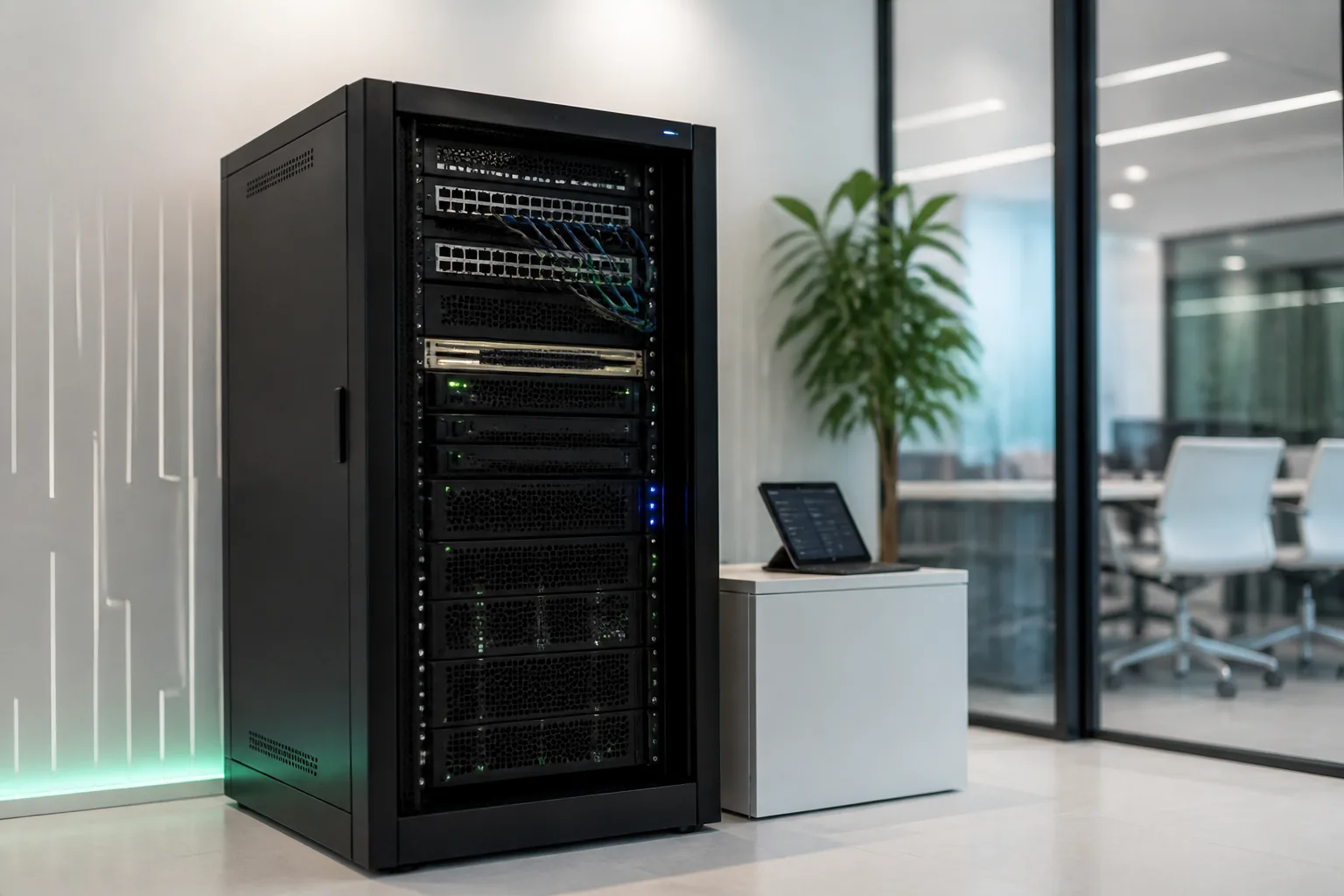
- On-premise: hardware inside your own facility, on your own network. Maximum control, and every operational responsibility comes with it.
Start with the transfer question, not the cost model
Cross-border transfer rules under Articles 22 and 23 of the UAE PDPL eliminate deployment options faster than any cost analysis, so resolve the legal constraint before you build a business case.
Teams routinely build a detailed cost comparison, present it, and then discover that the cheapest option cannot carry the data class in question. The analysis was not wrong. It was sequenced wrong.
Article 22 permits transfer to jurisdictions with an adequate level of protection. Article 23 covers the rest and narrows you to specific grounds, none of which sit comfortably under a long-lived internal system.
If your data class cannot leave the country on a durable basis, the first option is gone before you price anything. That is a two-hour conversation with counsel that saves a two-month procurement exercise.
Sector rules stack on top of the federal position. Abu Dhabi healthcare entities also answer to ADHICS, and DIFC-based firms to the DIFC Data Protection Law. Check the sector layer before concluding you are clear.
Is on-premise AI actually cheaper than cloud?
On-premise AI is cheaper than per-token pricing only when the hardware stays busy, because you pay for capacity whether or not you use it, so the break-even is set by utilisation rather than by total workload.
Per-token pricing is genuinely elastic. You pay for what you consume and nothing when idle. Owned hardware inverts that: the cost is fixed and the marginal token is close to free.
The break-even therefore depends on how full the box stays. A cluster running sustained batch work overnight and interactive load during the day will beat metered pricing comfortably. The same hardware serving a handful of daily queries is the most expensive option on this page.
Model the honest utilisation curve, not the launch-week one. In our experience the reliable pattern is document-heavy back-office processing, which runs continuously, rather than chat interfaces, which spike and then settle far below forecast.
Published analysis puts the crossover near two million tokens a day: below roughly one million, metered pricing wins outright, and above ten million owned hardware is generally reported to pay back within six to twelve months. Treat those as order-of-magnitude markers rather than gospel, because power, cooling and salary costs differ in the UAE.
The staffing line is the one most business cases omit entirely. Whoever runs the stack is a real salary, and in most models that person costs more than the GPUs they look after.
- Count total cost of ownership, not hardware: power, cooling, rack space, spares, and the engineering time to run it
- Include the model lifecycle, since open weights are replaced faster than depreciation schedules assume
- Separate the workloads that must be private from the ones that merely could be, and size for the first group only
- Batch and scheduled work is what fills the utilisation gap and moves the break-even in your favour
- ~2M tokens/day
- Reported crossover point where self-hosting starts to beat metered pricing Paolo Perrone, The AI Engineer
- 6 to 12 months
- Reported payback on owned hardware above ten million tokens a day Paolo Perrone, The AI Engineer
The GPU sits idle 22 hours a day, and you paid five figures for a machine that mostly waits.
What you give up on-premise
On-premise deployment costs you model freshness, elastic capacity and the vendor's operational staff, and those are real losses rather than rounding errors.
We build private AI appliances, so this section is against interest. It is also the part clients tell us they wish someone had said earlier.
The frontier moves quickly. An owned deployment tracks the best available open-weight models, which trail the leading proprietary models on the hardest reasoning tasks. For document extraction, classification, retrieval and summarisation the gap is usually immaterial. For genuinely difficult reasoning it is not.
Capacity is fixed. A quarter-end surge that a metered service absorbs invisibly becomes a queue on your own hardware. That is manageable with planning and unpleasant without it.
Somebody has to run it. Patching, model upgrades, GPU driver maintenance, monitoring and capacity planning do not disappear because the box is yours. Either you hire that capability, or you buy it as a managed service, and the second option is worth pricing honestly.
How we deploy and operate it for you
If the workload is difficult multi-step reasoning rather than document and workflow processing, be sceptical of anyone recommending on-premise without discussing the capability gap.
What you give up in the cloud
Managed AI services cost you control over retention, jurisdiction of the operator, model version stability and the ability to prove exactly what happened to a given record.
Retention is the one that surprises people. Your contract may say prompts are not retained, but demonstrating that to an assessor is a different exercise from asserting it, and you are relying on a control you cannot inspect.
Model versions move underneath you. A managed endpoint can change behaviour on the provider's schedule, which is awkward when you have validated a clinical or legal workflow against specific behaviour.
In-region hosting narrows but does not close the gap. Processing in a UAE region is a meaningful improvement over cross-border processing, and it still leaves you dependent on a foreign operator's controls and terms.
A decision framework that holds up
Choose on-premise when data cannot leave your control, utilisation is high and workloads are document-centric; choose in-region managed services when the data class permits it and demand is spiky; choose private tenancy when you need isolation without operating hardware.
Work through these in order. The first question that returns a hard constraint decides the outcome, and the rest become sizing detail.
- Can this data class leave the UAE on a durable legal basis? If no, you are choosing between private tenancy in-country and on-premise.
- Can it leave your own network at all, under sector rules or contractual commitments to your clients? If no, on-premise.
- Will utilisation sustain above roughly half of provisioned capacity within the first year? If no, owned hardware will cost more than metered pricing.
- Is the workload document and workflow processing, or hard open-ended reasoning? Open-weight models handle the first well today.
- Do you have, or will you buy, the operational capability to run inference infrastructure? If neither, choose private tenancy or a managed appliance rather than raw hardware.
The most common good answer we see in regulated UAE organisations is private, in-country infrastructure that they control but do not personally operate. It closes the transfer question without pretending the operations burden is free.
Frequently asked questions
- Is on-premise AI cheaper than cloud AI?
- Only at high utilisation. Owned hardware converts a variable per-token cost into a fixed capacity cost, so it wins when the hardware stays busy and loses badly when it sits idle. Model the realistic utilisation curve including power, cooling, spares and engineering time before comparing against metered pricing.
- Does the UAE PDPL require AI to run on-premise?
- No. The PDPL does not mandate on-premise deployment. It restricts transferring personal data outside the UAE, under Articles 22 and 23, which means processing must either stay in-country or rely on a valid transfer basis. In-region hosting and private tenancy can both satisfy that requirement without owning hardware.
- Are open-weight models good enough to replace frontier models?
- For document extraction, classification, retrieval, summarisation and structured workflow tasks, current open-weight models are generally sufficient in production. For difficult open-ended reasoning, leading proprietary models still hold an advantage. Match the deployment choice to the actual workload rather than to the benchmark headline.
- What is the difference between in-region cloud and private tenancy?
- In-region managed services keep processing inside a UAE data centre but run on shared infrastructure operated by a foreign provider under their terms. Private tenancy dedicates infrastructure to you, typically with network isolation and customer-managed keys, which gives stronger control over retention and access while still avoiding hardware ownership.
- What operational capability do we need to run AI on-premise?
- At minimum: GPU and driver maintenance, model serving and version upgrades, capacity planning, monitoring, patching and backup. Most mid-market organisations do not have this in-house at the start, which is why a managed appliance model, where the vendor operates the stack inside your facility, is often the practical middle path.
Sources
- 1.Federal Decree-Law No. 45 of 2021 on the Protection of Personal DataUAE Legislation
- 2.United Arab Emirates data protection law overviewDLA Piper Data Protection Laws of the World
- 3.AI regulation scanner: United Arab EmiratesCMS Expert Guides
- 4.Abu Dhabi Healthcare Information and Cyber Security Standard (ADHICS) v2Department of Health, Abu Dhabi
- 5.Should you self-host LLM inference? Cost and risk guide (18 July 2026)Paolo Perrone, The AI Engineer
Read more
DIFC Regulation 10: what full enforcement means for your AI systems
Not new law. Introduced in September 2023, enforced from January 2026. The four obligations, who they fall on, and why no vendor can sell you the certificate.
Oct 2, 2026
The UAE's Federal Authority for AI and Data: what actually changes
A Cabinet-level regulator consolidating three bodies. What it covers, what it does not change today, and the artefacts worth building before the rules settle.
Sep 25, 2026
UAE PDPL and AI: what the 2027 deadline actually requires
Everyone quotes 1 January 2027. Far fewer can say what it rests on. How the PDPL applies to AI systems, which articles matter, and what to fix first.
Sep 4, 2026
Bring AI inside your walls.
Talk to us about a private, compliance-ready deployment for your organization.