 Lenouar
Enterprise AI agents with human approval and audit trails.
Agentic workflows that watch events, prepare work, call internal tools, and pause for approval before consequential actions, built for regulated teams.
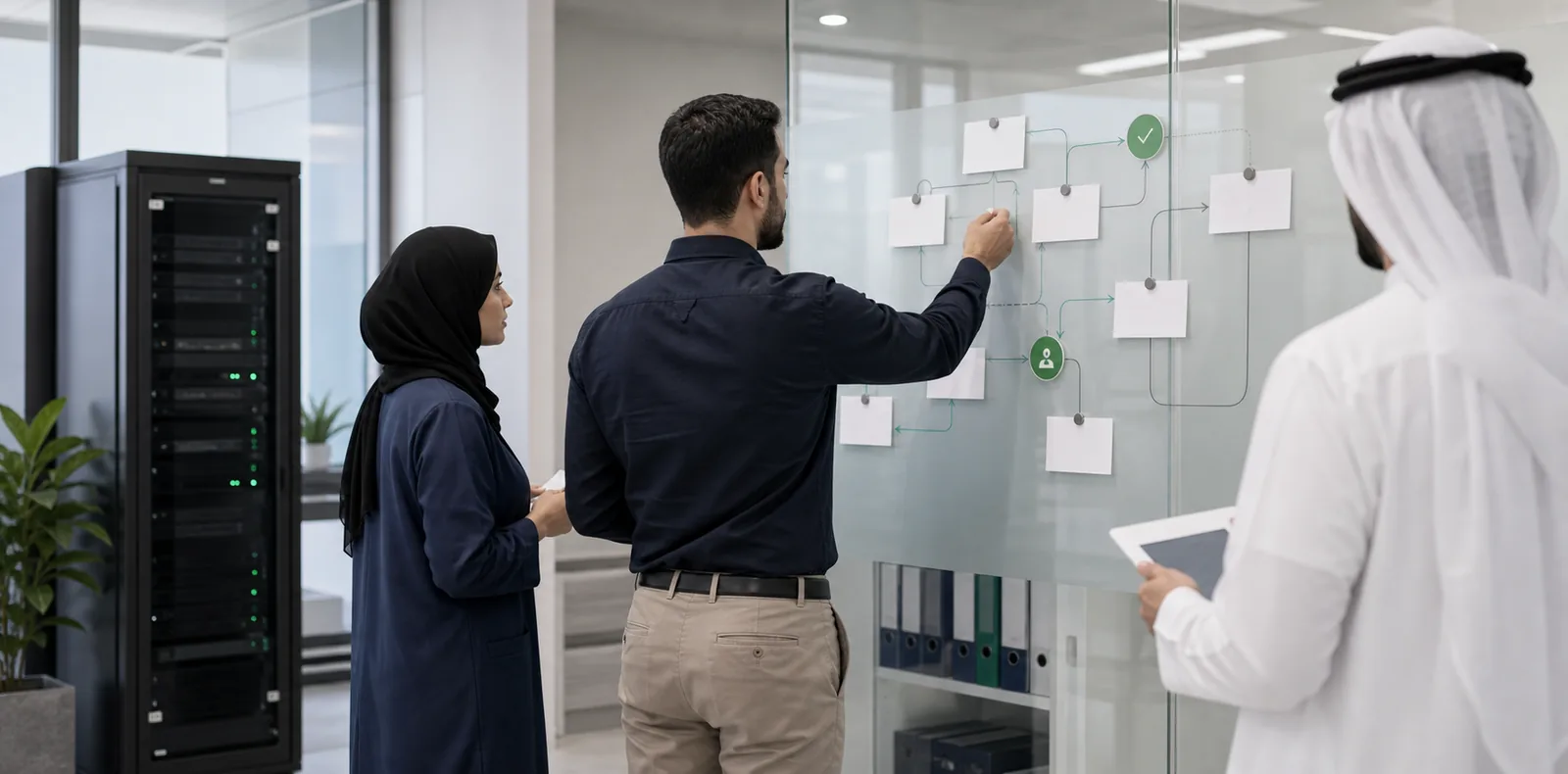
Agents built for real operations
Enterprise agents should not behave like uncontrolled bots. They need clear triggers, permissions, tools, fallback behavior, and human checkpoints.
Lenouar designs AI agents as operational workflows that can work inside the organization's own environment and connect to the systems teams already use.
Event triggers, tool calls, and approvals
A governed agent workflow usually follows a simple pattern.
Agent operating loop
- An event happens, such as a ticket, document, email, or system update.
- The agent retrieves the approved context.
- The agent prepares a recommendation, draft, or action.
- A human approves, edits, or rejects the output where required.
- The system records the action, source context, reviewer, and result.
This is automation with operating controls, not AI left alone.
Department agent examples
The same private agent layer can serve multiple teams with different permissions.
Examples
- Support agent that drafts replies and updates tickets after approval.
- HR onboarding agent that checks missing documents.
- Finance agent that prepares reconciliation notes.
- Compliance agent that collects evidence and flags gaps.
- Legal agent that summarizes documents and prepares review packs.
- Operations agent that triages incidents and assigns follow-up tasks.
Permissions and guardrails
Each agent needs a boundary. It should know what it can read, what tools it can call, what actions it can prepare, and when it must stop.
Lenouar defines these boundaries before implementation so the agent fits the organization's risk appetite and approval culture.
Private node or hybrid agent runtime
Agents can run on a private node for sensitive, routine, and always-on work. For occasional heavier reasoning, the workflow can route to approved external or UAE-hosted models if policy allows.
The agent runtime, retrieval layer, tool permissions, and audit logs remain under the operating model Lenouar configures.
The first agent to build
The best first agent is narrow, repetitive, and easy to evaluate.
Selection criteria
- The workflow happens often.
- Inputs are reasonably structured.
- A human owner already reviews the outcome.
- Time saved can be measured.
- Risk can be controlled with clear approval gates.
This creates momentum without overpromising full autonomy.
To scope that first workflow with our team, see workflow automation and AI agents.
Read more
All articlesDIFC Regulation 10: what full enforcement means for your AI systems
Not new law. Introduced in September 2023, enforced from January 2026. The four obligations, who they fall on, and why no vendor can sell you the certificate.
The UAE's Federal Authority for AI and Data: what actually changes
A Cabinet-level regulator consolidating three bodies. What it covers, what it does not change today, and the artefacts worth building before the rules settle.
UAE PDPL and AI: what the 2027 deadline actually requires
Everyone quotes 1 January 2027. Far fewer can say what it rests on. How the PDPL applies to AI systems, which articles matter, and what to fix first.
Bring AI inside your walls.
Talk to us about a private, compliance-ready deployment for your organization.