Running DeepSeek and other open models on your own hardware
DeepSeek's app stores data in China. Its open models can run on your own hardware. What that takes, why Ollama is not enough, and how to vet a model.
Key takeaways
- DeepSeek's app and API are a hosted service. Its privacy policy says the data is stored in China.
- DeepSeek also publishes its model weights under the MIT license. Anyone may download and run them.
- A model running on your own hardware sends nothing out. It is a file, and the computing happens on your GPUs.
- Ollama is the quick way for one person to try a model. Serving a whole organization needs a serving engine.
- The model is the small part. Access control, logging and your own documents are the rest.
You can use DeepSeek without sending data to China if you run the model yourself. The app and the model are two different things, and only one of them sends anything anywhere.
When someone types into the DeepSeek app, the text goes to DeepSeek's servers. The company's privacy policy says it collects, processes and stores that information in the People's Republic of China. For most regulated work in the UAE, that ends the conversation.
The model is another matter. DeepSeek publishes the weights, the large file that is the model, under the MIT license, which permits commercial use. Download that file, load it on GPU servers in your own building, and you have the same model with no connection to DeepSeek at all. Your prompt goes from a staff member's screen to your server and back. The server does not need the internet to answer.
This is true of every open model, including Meta's Llama family and the UAE's own Falcon and Jais. DeepSeek is simply the one people ask about.
What it takes to run one
Size decides the hardware.
We size the hardware to the work, and say so when a smaller model will do.
- DeepSeek's current models need several servers. The smallest of its latest generation has 763 billion parameters, and the largest about 1.6 trillion. Running either is a multi-server installation.
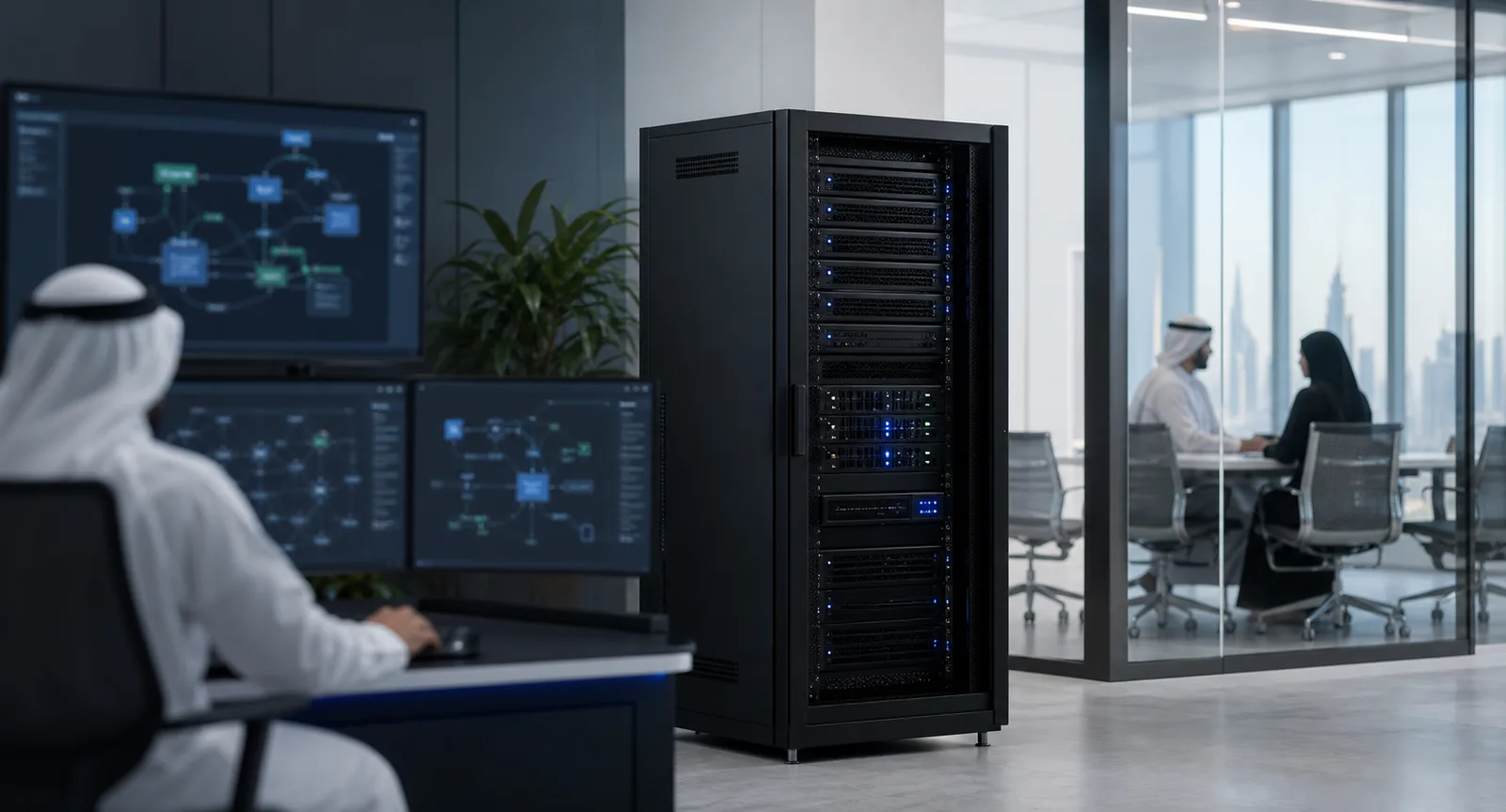
- Mid-sized open models fit a single node. Our AI Node carries two data-center GPUs and serves open models of up to about 70 billion parameters. For reading, summarizing, drafting and answering from documents, that is the size most work needs.
- Bigger is not always better. A smaller model that answers quickly, from your own documents, is often more use than a larger one that keeps staff waiting.
Why Ollama on a laptop is not a service
Ollama is free, open source, and the fastest way for one person to try a model. Install it, type one command, and you are talking to a model on your own machine. Every technical team should try it.
Serving a whole organization at once is a different job. A serving engine such as vLLM batches many requests together on the GPU, which is what keeps answers fast when everyone asks at the same time. In Red Hat's published benchmark on the same hardware, vLLM reached 793 tokens per second at peak, against 41 for Ollama.
We serve models with vLLM for that reason.
- 793
- tokens per second at peak with vLLM, in Red Hat's benchmark Red Hat Developer
- 41
- tokens per second at peak with Ollama, on the same hardware Red Hat Developer
The model is the small part
A model on a server is a demo. An organization needs the parts around it.
- Who may ask what. Access by role, so the model cannot hand a finance document to someone outside finance.
- A record of every request. Who asked, what was retrieved, which model answered. This is what lets you investigate an incident.
- Your own documents. Answers drawn from your policies and files, with the source shown beside each one.
- Arabic and English. Tested in both, on your material.
- A plan for the next model. Open models improve every few months. Swapping one in should be a planned change with a test, not a rebuild.
Checking an open model before you trust it
- Take the weights from the publisher. Download from the model maker's official repository and verify the checksum.
- Test it on your own work. Use real documents, in Arabic and English, and score the answers. Public leaderboards do not know your subject.
- Know where it came from. A model reflects how and where it was trained. Read its answers on topics that matter to you before staff rely on it.
- Keep it disconnected. A model server needs no route to the internet. Do not give it one.
Frequently asked questions
Is DeepSeek safe to use for business?
The hosted app stores what you type on servers in China, according to its own privacy policy, so it is not suitable for confidential or regulated data. The open model, run on your own hardware, sends nothing out.
Can DeepSeek run offline?
Yes. Once the model files are on your servers, they need no internet connection to answer.
Is DeepSeek free for commercial use?
DeepSeek publishes its model weights under the MIT license, which permits commercial use. Check the license on the specific model you download.
Should we use Ollama or vLLM?
Ollama for one person trying a model. vLLM, or a similar serving engine, for many people using it at once.
Do we need a data center?
Not always. Smaller appliances run on standard office power and cooling. Larger models need rack space.
Sources
- 1.DeepSeek Privacy PolicyDeepSeek
- 2.DeepSeek models and licensesHugging Face
- 3.Ollama vs. vLLM: a deep dive into performance benchmarkingRed Hat Developer
- 4.Ollama source code and licenseGitHub
Read more
A ChatGPT Enterprise alternative that runs on your own hardware
ChatGPT Enterprise now stores data in the UAE, but it is still OpenAI's cloud. What that covers, what it does not, and when to run AI on your own hardware.
Nov 24, 2026
Private RAG, explained: AI that answers from your documents and shows where
RAG lets AI answer from your documents and show its sources. How it works, where it fails, and why the index must stay inside your own environment.
Nov 24, 2026
Agentic AI, with a person approving what matters
Agentic AI takes steps instead of only answering. How an agent works, the actions a person must approve, and why agents belong inside your own network.
Nov 24, 2026
Bring AI inside your walls.
Talk to us about a private, compliance-ready deployment for your organization.