 Lenouar
DME claims fail on paperwork that was never captured at the point of care.
A certificate of medical necessity that is missing, a preauthorization that was never recorded, a maintenance visit nobody logged. We build the system that captures each of these as the work happens, so the claim and the audit both hold.
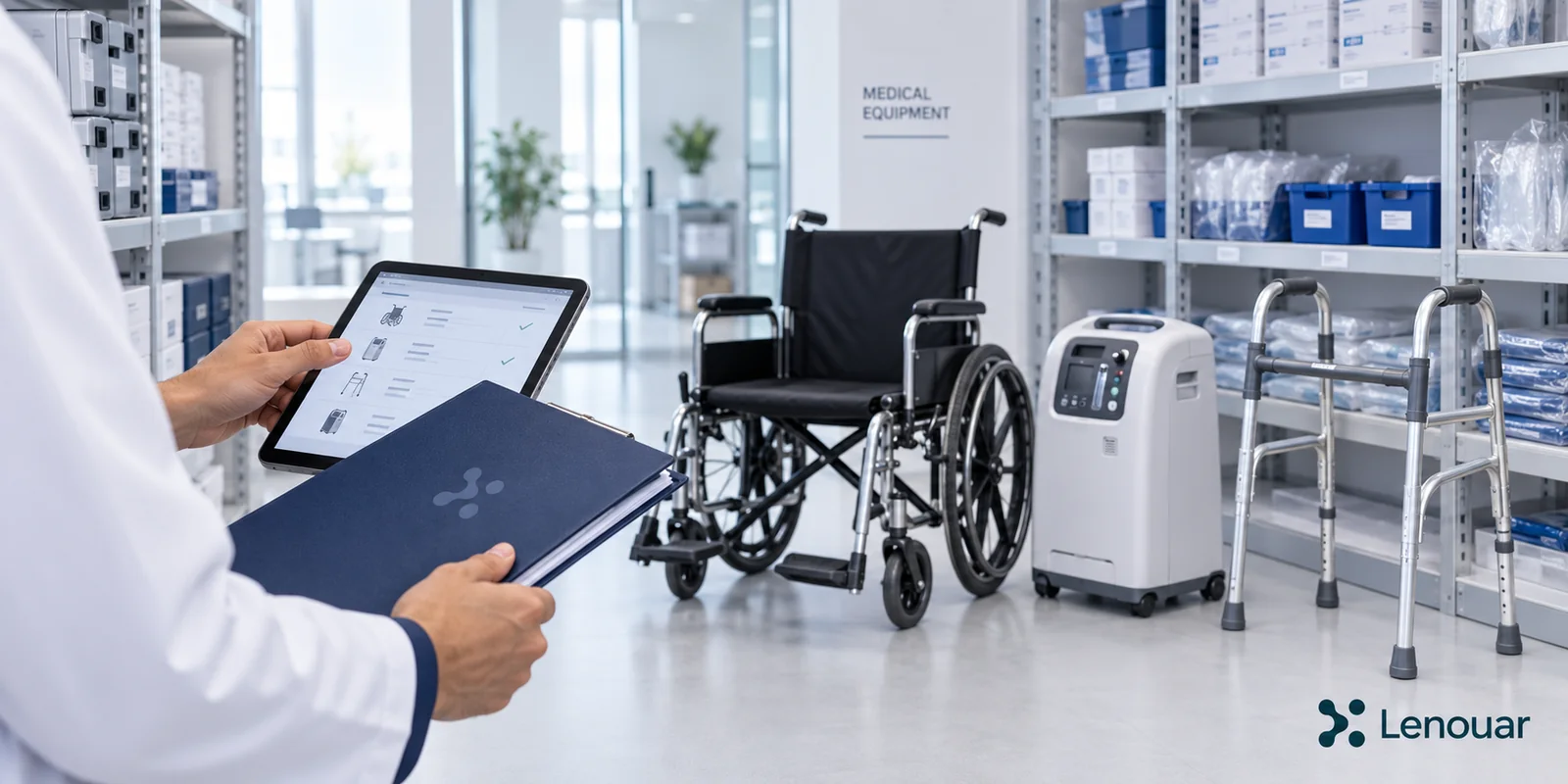
The DoH policy on Durable Medical Equipment
The Department of Health drafts and oversees the Policy on Durable Medical Equipment, aligned to UAE health insurance law and MOHAP regulation. The current version carries the reference Policy/DME/HPS/V2/2026.
What the policy fixes in place
- The treating physician conducts an evidence-based DME assessment before a prescription is issued.
- A certificate of medical necessity accompanies the prescription, alongside any electronic preauthorization request.
- The DME benefit is available only through the payer's network of DoH-licensed healthcare providers.
- Devices purchased outside Abu Dhabi without payer pre-authorization are excluded from coverage.
- The dispensing entity remains responsible for maintenance after the device leaves the building.
Coverage lists, eligibility and limits sit in the policy and its annexes and change by circular, so the system has to treat them as configuration rather than as hard-coded rules. That is a design decision, and most DME software gets it wrong.
Preauthorization and medical necessity
The paperwork is the claim. If the certificate of medical necessity and the authorization are not captured and linked at the point of care, the denial arrives weeks later and the device has already been dispensed.
What the workflow enforces
- The clinical assessment recorded against the patient and the prescriber, before a prescription can be raised.
- The certificate of medical necessity captured as structured data, not as a scan nobody can query.
- The preauthorization request assembled with the prescription and the certificate attached, and the payer response recorded against it.
- A block on dispensing where authorization is absent, with a named override and a reason when a clinician decides otherwise.
- The full chain retained: assessment, prescription, certificate, authorization, dispensing, delivery.
That last line is what turns a disputed claim into a document you can send.
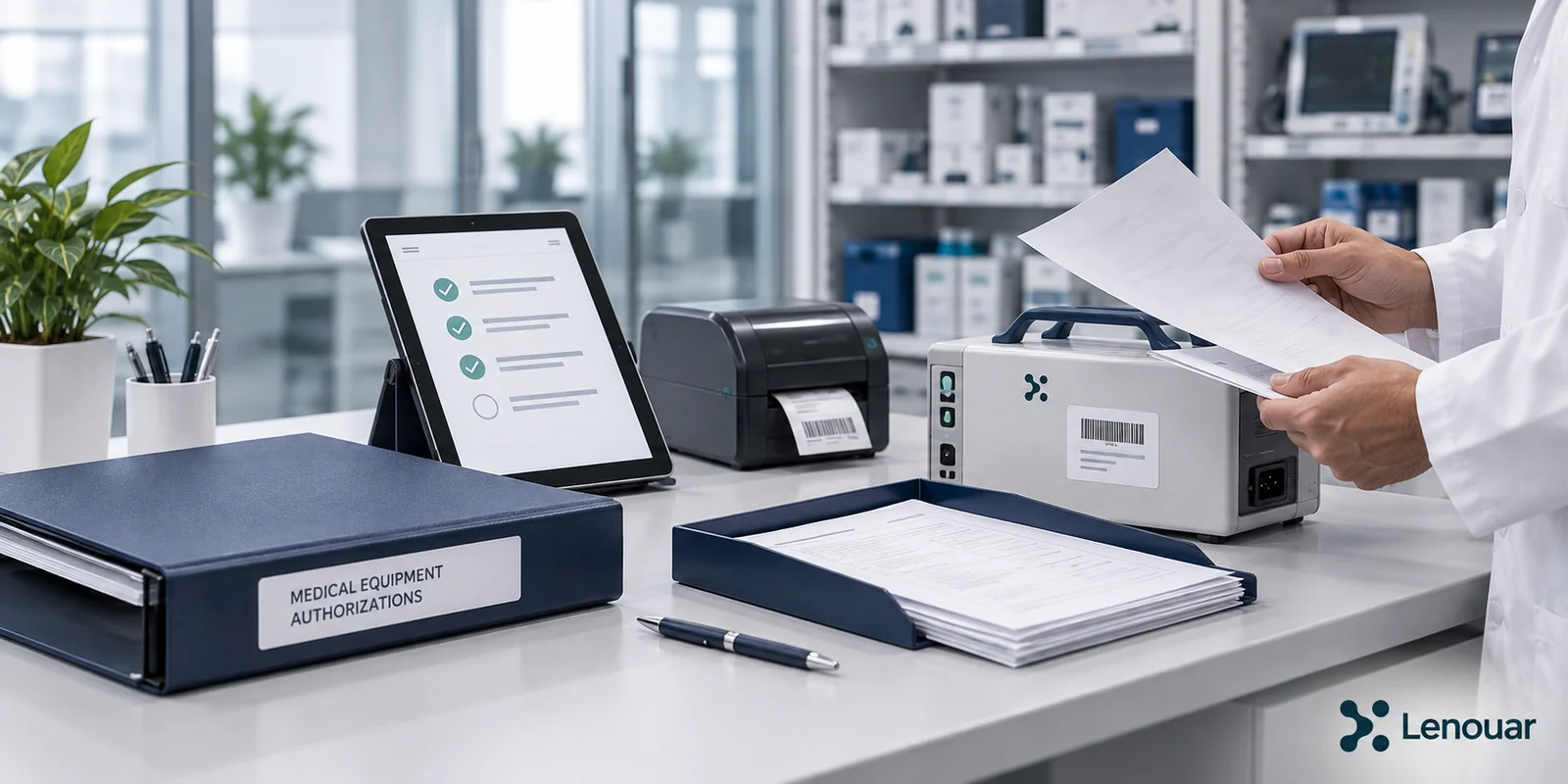
Dispensing, inventory and serial tracking
DME is physical. A device has a serial number, a warranty, a location and a patient, and losing any one of those creates a problem that paperwork cannot fix.
What we track
- Device identity: model, serial number, supplier, purchase date and warranty position.
- Where it is now, and who holds it: patient, ward, store or out for repair.
- Rental against sale, with the obligations each carries.
- Returns, refurbishment and reissue, with the device history following the unit rather than resetting.
- Stock levels against demand, so a preauthorized device is actually available to dispense.
For a provider running rentals across multiple sites, this is the difference between an asset register and a guess.
Preventive and corrective maintenance
The policy leaves maintenance responsibility with the dispensing entity. Service, corrective and preventive maintenance all stay yours after the device is in the patient's home.
What the system schedules and proves
- Preventive maintenance due dates per device class, driven by the manufacturer's interval rather than by memory.
- Corrective maintenance raised against the device, with fault, action and parts recorded.
- Engineer visits, with completion evidence attached to the device history.
- Devices overdue for service surfaced before they become an incident, not after.
- A per-device service record you can produce when an assessor or a payer asks.
This is also where an ADHICS assessment touches DME, because a connected device is an information asset and its maintenance and access records are in scope.
What we build
We build the DME platform and connect it to the systems you already run, so the clinical, authorization and logistics records stop living in three places.
A typical engagement
- Map the current path from assessment to dispensing to maintenance, and find where records go missing.
- Build the workflow with authorization and medical necessity enforced at the point they are created.
- Connect to the EHR for the clinical side, and to inventory and finance for the device and claim side.
- Migrate the existing device register, serial numbers and service history.
- Hand over with the maintenance schedule running and the audit trail populated.
It deploys inside your environment. Patient-linked device data falls under the same residency and access rules as the rest of your clinical record, so it stays where your other patient data stays.
Read more
All articlesDIFC Regulation 10: what full enforcement means for your AI systems
Not new law. Introduced in September 2023, enforced from January 2026. The four obligations, who they fall on, and why no vendor can sell you the certificate.
The UAE's Federal Authority for AI and Data: what actually changes
A Cabinet-level regulator consolidating three bodies. What it covers, what it does not change today, and the artefacts worth building before the rules settle.
UAE PDPL and AI: what the 2027 deadline actually requires
Everyone quotes 1 January 2027. Far fewer can say what it rests on. How the PDPL applies to AI systems, which articles matter, and what to fix first.
Bring AI inside your walls.
Talk to us about a private, compliance-ready deployment for your organization.